
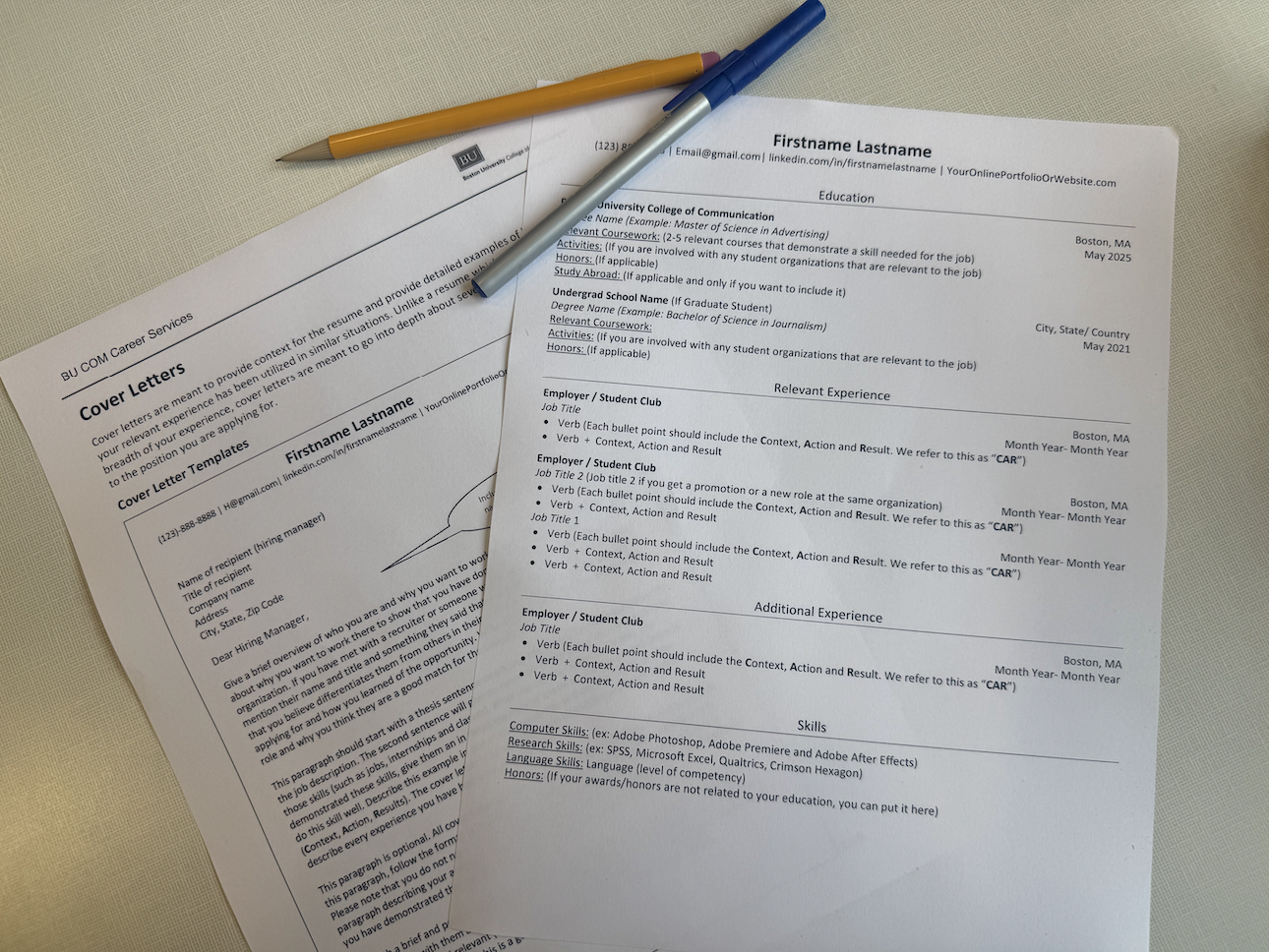
For college students, landing an internship can feel just as important as earning a degree. But even students who start applying months in advance and send out dozens of applications say they are struggling to get their foot in the door.
In a world where generative AI continues to spread while entry-level positions disappear, how can Boston University College of Communication (BU COM) students get their applications to rise to the top of the pile?
The first step: Emphasize quality over quantity. Sending out applications is easy, but you need to consider whether those applications represent who you are and what sets you apart from other applicants.
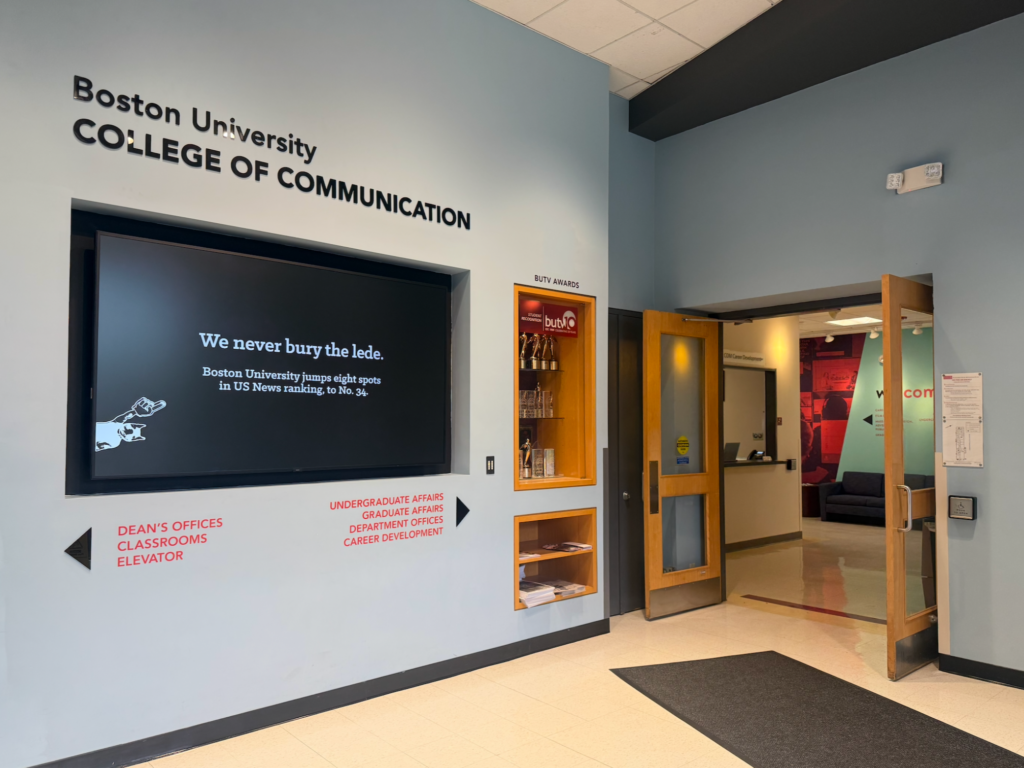
Craig Sender, an adjunct lecturer in BU COM and senior director of public and analyst relations at Copyright Clearance Center, said one of the first mistakes students make comes before they even begin writing the body of their cover letter.
“When you’re addressing the cover letter, you never address it as ‘Dear Hiring Manager,’” he said. “You always find a name.”
The name may not always appear on the application. Sender recommends students search the company’s website and LinkedIn page and, if they still cannot find it, call the company and ask. Using the hiring manager’s name can show that you’ve taken the time to research the company and haven’t just sent in the same application to multiple employers.
Finding the right name, however, is only the first step. You can further individualize your cover letters by researching the company you’re applying to. “Talk about something that they’ve done recently in the cover letter,” Sender said. “Like, a campaign that they recently did or some positive news coverage they got.”
Siddhi Choubey, a media science graduate student with a focus in marketing communication research, works at BU COM Career Services and echoed Sender’s emphasis on individualizing cover letters.
“With cover letters, sometimes people will write the same experience for every position,” Choubey said. “They tend to not use that opportunity enough and talk about their passions, talk about their interests, and talk about why they genuinely applied for a job.”
Choubey said this may stem from a lack of confidence she sees among students, particularly in their resumes. “They don’t believe in themselves, which reflects on their resume,” Choubey said. “One of the core things we do here is make people realize what a strong resume they have, because a lot of people don’t know how capable they are.”
Sadie Shelkey, a BU COM senior, worked as a production assistant at Flying Scooter Productions in Pittsburgh last summer. Although she secured an internship, she still has not mastered the application process. “I was applying within the entertainment and advertising sphere,” she said. “You don’t really get a lot of feedback on them, so I don’t really know what works and what doesn’t work.”
Shelkey said she follows a lot of the conventional wisdom about what a resume should look like while continuously adjusting her cover letter to reflect her desired position.
While Shelkey’s story is a success, she experienced a struggle similar that many COM students face. “I did put in, like, 80 applications to internships throughout the fall and spring, and this was one of the ones toward the end.”
Many students focus on the materials they send to prospective employers, but Sender said professional social media profiles, such as LinkedIn, are just as important, especially with the rise of generative AI.
“If everybody’s using AI, all resumes look generic,” he said. “What I do, personally, is, instead of looking at the resume, I’m going to your LinkedIn page. That’s where I’m getting the real story.”
Many students, however, shy away from actively using LinkedIn, especially when the platform can feel unproductive.
“I do use LinkedIn,” Shelkey said. “I don’t post terribly often, but I have it all always updated. I feel like a lot of the content I see on LinkedIn is super-repetitive, just kind of people trying to one-up each other or complain about the job search.”
While becoming active on LinkedIn can help promote student- applicants in the age of generative AI, the resume and cover letter are not the only parts of the process where AI comes into play.
According to Sender, knowing how to use AI is also critical to securing a role in today’s job market. “If I’m interviewing somebody, and I ask them the AI question, and they say ‘I’ve never used AI before,’ that’s a red flag for me.”
Some applicants may think that’s what employers want to hear, but Sender says students in communications should know how to use the technology.
Although there is no perfect science for internship applications, there are tactics students can use to distinguish themselves from the sea of applicants. For Choubey, those tactics ultimately start with confidence in one’s own skills and qualifications.
As the job market changes and AI becomes more prevalent, the application process can feel intimidating, but students shouldn’t shy away from showcasing what makes them strong candidates.
“I hope that people don’t underestimate themselves.”
Alexandra Ruane is a strong communicator pursuing a degree in journalism and a minor in psychology. She hopes to use her multimedia skills and passion for the human mind to create engaging and thoughtful content.



Leave a Reply