
Clearing the air on our reputation and offering some advice on how to manage your own.
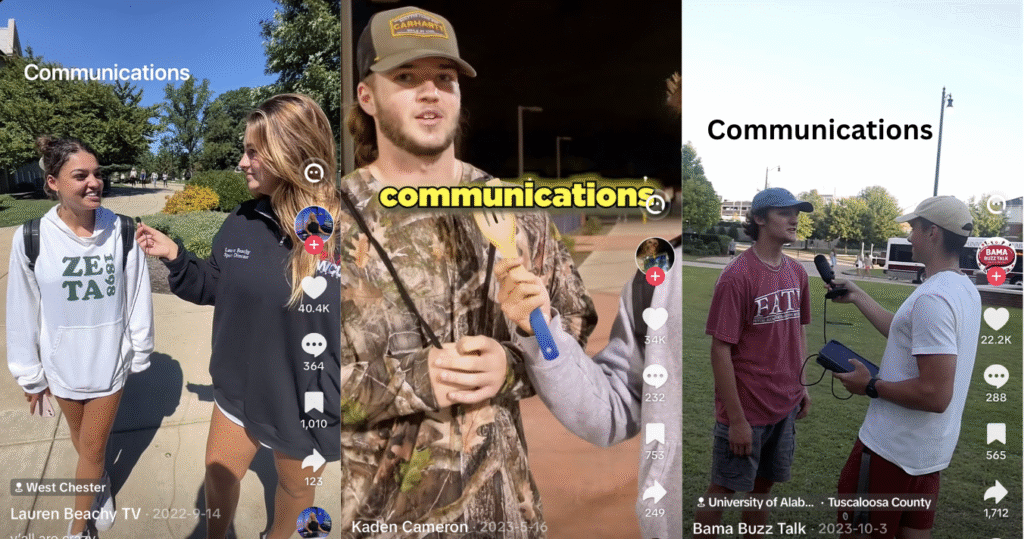
“What’s the dumbest major?”
“Communications.”
You may have seen this trend circulating on social media, or maybe you’ve even heard this take in everyday conversation. I certainly don’t mean to start a “war of the colleges,” but rather, to communicate the value of what we actually do at COM – specifically, The Department of Mass Communication, Advertising, and Public Relations – because you generally know what journalists and film and TV majors are up to.
“I think people assume that if you’re in something like engineering or math or computer science that you’re smarter than someone in communication, and I feel like it’s a little bit unfair because people just have different career goals,” said COM Student Government President Nick Harris. “Oftentimes, you’ll see people in communication working in the same space as people in business or engineering or data science.”
“Everyone in Questrom, we think we’re top dog,” said Claire Moore, business major and co-editor in chief of The Buzz Magazine. “But I think honestly Questrom and COM are really neck and neck just because we’re so hand-in-hand. I think COM is just kind of more qualitative and Questrom’s more quantitative.”
It’s true. Communications students are not typically crunching numbers (even though we earn a Bachelor of Science degree). We are, however, absolutely essential to building and maintaining reputations. Even if you don’t run a business or have any interest in the intricacies of communications strategy, the fundamentals of a COM education are valuable and practical skills for everyone to have.
“What we’re trying to do is teach a generation of students to express and articulate their ideas and their intelligence,” said Michael Dowding, master lecturer at the College of Communication. “Not only to convey information, but to do so in a way that breaks through a very crowded media market and that resonates with readers [and] makes them want to continue to read.”
Want to stand out against the competition in your networking and job searches? Here are five skills COM majors have mastered that you should add to your professional toolkit.
- Email Etiquette
Your emails, even down to when you hit send, can make or break a professional relationship. Of course there’s the basics of always including a greeting and sign-off, but there’s more to it than that.
- Be polite. As you know from texting, tone sounds different when words are written. Be mindful of your word choices and sentence structures. You don’t want to come off as rude.
- Break up the text visually. Need to cover a lot of different topics? Give each topic its own indented paragraph. Need to send availability options for a meeting? Offer a vertical list of times. You don’t want it to be a chore for the recipient to find the information they need.
- Stay within business hours. Nobody appreciates an email at 2 a.m., and it will likely get lost to the bottom of their inbox by morning. (Schedule-send is my best friend.)
2. Knowing Your Audience
This is important in COM because it gives us a better sense of what will resonate with key audiences. I first learned the concept during family games of Apples-to-Apples with the phrase “you gotta know the judge.” Not only is this a winning strategy for cards, it’s solid life advice. Not everyone will think the same things are funny, and not everyone processes information with the same context. Do your research, or at the very least, read the room.
3. Awareness of Cultural Climate
Don’t just know your audience — be sensitive to them. Think before you speak/type, and consider how current events could impact the way your seemingly harmless words will be received. Even if you think you know the judge, pay attention to what kind of day they might be having.
We’ve all seen companies suffer in the media because of their PR team’s negligence. Remember that the same thing can happen to you, even if it’s on a smaller scale. Read the news, put yourself in another’s shoes, and avoid unintentional bridge-burning.
4. Media Literacy
Especially with the rise of increasingly sophisticated generative AI, it’s vital to discern the “realness” of anything you see online as quickly and accurately as possible.
“I think that media literacy is so important, and we cover that a lot in COM,” said graduate student Sophia Featherstone. “Media literacy can only benefit you, especially with how much media people consume in today’s world.”
In other words, be less gullible than that person who sends you fake news on Instagram reels.
5. Spelling and Grammar
It may seem like we’re going back to elementary school with this one, but your credibility relies on knowing how to write correctly. A single typo or misused word will have your reader wondering if they should be reading your work in the first place.
“We’re trying to foster a culture of creating elite writers who can be counted on and trusted to tell the story truthfully…and do so in a way that is engaging and entertaining,” Dowding said.
And Finally, a Note on AI:
“It’s a helpful tool,” said Harris. “But I don’t think you can replace relationship-building with AI. We’ve seen what happens when that happens. People don’t like it. People aren’t receptive to it…because people like the human aspects.”
Sure, it’s a helpful proofreader—but so are your peers. Ultimately, you’re writing to communicate with other people, so who’s better suited to read over your draft than another actual person?
Mistakes are a normal and human part of the learning process, but that process only helps you improve if you do the work yourself. Practice makes perfect, not ChatGPT. And if you’re dying for an expert opinion, maybe use your newfound email skills to contact a COM major.
“It’s not that I need a non-COM major to appreciate the nuances of what a COM grad brings to the table,” said Dowding. “But what I want and what I expect is that when [they] see a COM grad out there, they can respect what that person brings and say ‘OK, I know I can trust the communications, the articulations of our messages to this person… This COM person is a full partner to that very crucial process of articulating it and communicating it to the world in ways that are accurate, impactful, and memorable.”




Leave a Reply