
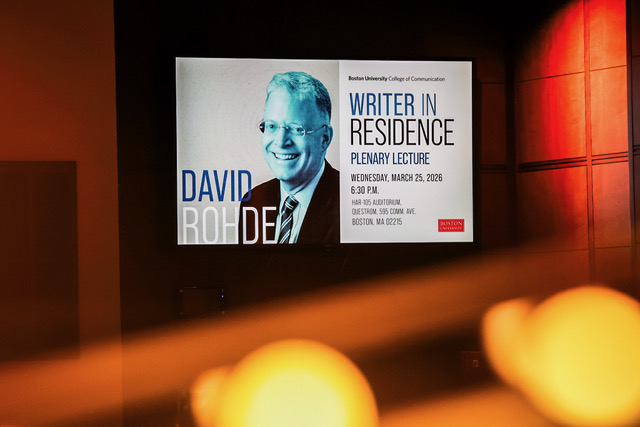
Hidden away for months by the Taliban in the foothills of the Hindu Kush mountains, author and journalist David Rohde certainly had plenty of time to develop what any writer values: his voice. Unfortunately for him, his captors were less interested in his writing voice and more interested in his literal voice. After being forced to stammer through Taliban songs about war and weapons, Rohde disarmed his kidnappers (metaphorically) with renditions of… The Beatles.
“There I was, thinking of my wife and her recent letter delivered by The Red Cross,” said Rohde during a plenary lecture before hundreds of BU students in Questrom’s HAR-105 auditorium. “So I started singing the first verse of ‘She Loves You’ with the guards and my fellow prisoners joining in on the ‘Yeah, Yeah, Yeah’ chorus – with Kalashnikov rifles lying on the floor next to us.”
It was a long journey from southwest Pakistan in 2009 to Commonwealth Avenue for the College of Communication’s 2026 Writer in Residence last week, where Rohde delivered timely (and timeless) lessons about writing, journalism, and his uncommonly impressive career. The three-time Pulitzer Prize-winning foreign correspondent, editor, and writer shared numerous insights, humble examples, and anecdotes from his stops at The New York Times, The Christian Science Monitor, and The New Yorker. Most recently, he’s been reporting at MS-NOW, where he’s a frequent contributor on “Morning Joe,” and other shows/streams.
Now in its fourth year, the Writer in Residence program–made possible through a generous gift from Tom Schoenenberger (COM ’72)–brings a seasoned professional from the world of communications media to BU campus. During the annual residency, students gain a clearer view into the world of professional writing and the central role it plays in communications careers.

In his visits to nine different classrooms, Rohde shared writing excerpts from earlier in his career, discussing how his writing evolved, how he cultivates sources, and how he strives to maintain an unbiased reporting voice to remain credible.
“My editor at MS-NOW told me clearly: ‘We have others who deliver opinion programming,’” he said. “‘We need you to give us factual reporting.’ I’m a nerd for reporting, so that suits me perfectly.”
One highlight of the residency took place in Professor Mike Dodge’s CO 201 classroom when Rohde delivered a livestream segment with his MS-NOW colleagues on “It’s Happening with Velshi & Ruhle.” The “hit” gave students a front-row seat to modern journalism in 2026. Earlier, Rohde met with journalism students in the COM Writing Center to review their work in process and talked shop with several Writing Center tutors.
At his plenary lecture, Rohde spent an hour talking about the critical roles of sincerity, dialogue, and empathy in reporting before fielding questions from students.
“In this era of hyper partisanship and rampant online conspiracy theories, we need nonpartisan public servants for our country, our society and our democracy to function,” he said. “Apathy is the enemy, and hopelessness is the enemy. But I’m optimistic about this nation and this world – in part because of organizations like COM and young aspiring journalists like you.”
Although Rohde’s TV demands unexpectedly increased (following the outbreak of the U.S.-Iran war), the trimmed schedule didn’t diminish the enthusiastic reception from COM students and faculty.
I’m optimistic about this nation and this world – in part because of organizations like COM and young aspiring journalists like you.
“My students were astounded by David Rohde,” said Susan Carlton, senior lecturer, who hosted two classroom visits. “I’ve heard from a number of them expressing thanks and appreciation – one used the phrase ‘life- changing.’ Students were moved by David’s honesty, optimism, and humility.”
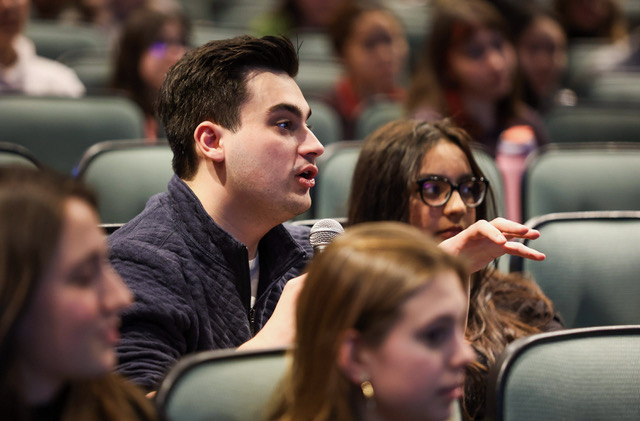
Other students submitted written feedback and analyses for their classes. “Attending David Rohde’s lecture left me thinking deeply about what it means to practice journalism with purpose in what he described as ‘a world in crisis,’” wrote one.
“[His] story is incredibly inspiring and goes to show the value of dialogue and just how far communication can go,” another student wrote. “Sincerity, dialogue, and empathy won’t be easy,” said Rohde at the conclusion of his plenary lecture, “and they won’t always work. But I promise – they’re worth trying.”
The COMmunicator Staff is a group effort of editors and writers at the COMmunicator publication.


Leave a Reply