

It’s an early Monday morning. Hot coffee burns your tongue, but your focus on reading the news dampens the pain. You’re on your favorite website — The New York Times — and click an article from your favorite reporter. She writes with such comedy and creativity. Another reporter just published a lifestyle article about love, and another just exposed corrupt activity in a foreign country.
Stop. Now picture all of The New York Times articles written by a computer. Imagine all stories from every news outlet written by something not human, but rather, something artificial.
Would the news be the same?
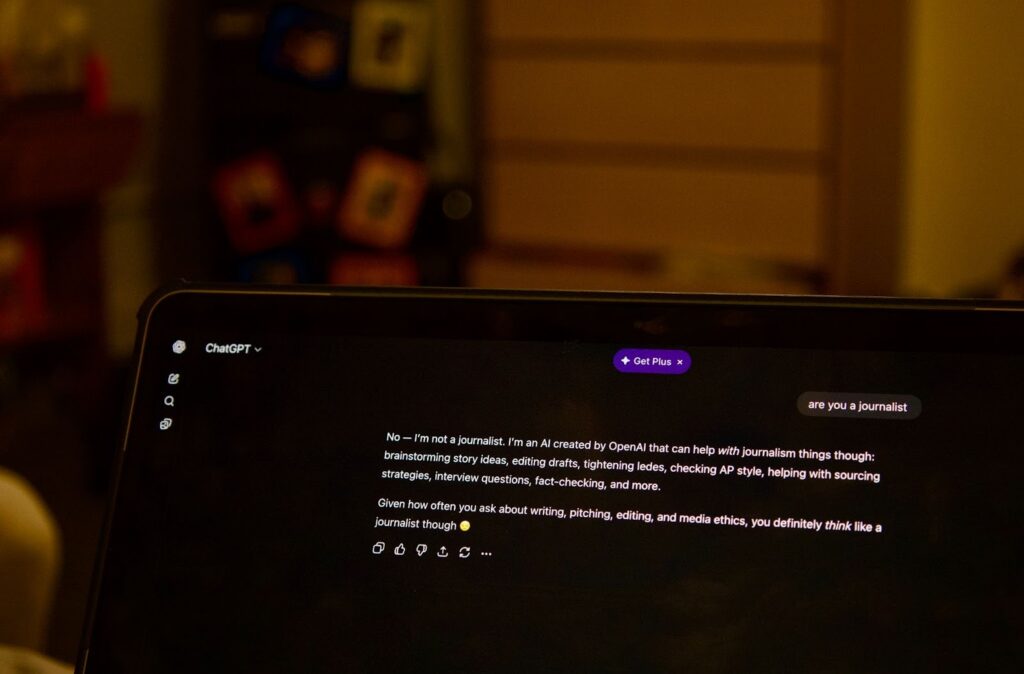
“I don’t have human experience in journalism — no press passes, deadlines, or editors breathing down my neck — but I’m trained on a massive mix of news writing, investigative reporting, ethics codes, and storytelling styles,” ChatGPT wrote.
So much of journalism involves telling facts and following a tight format. Artificial intelligence can easily replicate these structured aspects of journalism. Yet, we do not know how much it can truly replicate. Overall, the blaring question is: Can the entire journalism field be replaced by AI?
A Nieman Lab survey in 2025 found that 56% of journalists use AI weekly in a professional capacity, including 27% who use it daily. The same study found that journalists use AI mostly for grammar and other language processing. More than one-fifth of the surveyed journalists use it at least monthly for story research, idea generation, and writing parts of texts.
“I encourage my students to use it in ways that make their work more efficient, which is how I see newsrooms using it,” said Megan Stoessell, senior lecturer in BU’s Department of Journalism. “You can ask AI ‘What is happening in Boston this week?’ or ‘What food trends are popping up?”’
Whether it’s for basic facts, editing, or in-depth research, there is little doubt that AI is an efficient resource. In fact, some in the industry think AI can help journalists free up time for more complex journalism.
“I think it’s going to allow independent journalists to do more because they’re able to have high level, edited work without actually having to work for a larger publication,” said Cooper Formica, sophomore journalism student. “We’re going to have a lot more investigative journalists and people doing much more complex reporting because of AI.”
While it can be helpful, journalists must be cautious. According to MIT, AI platforms “provide users with fabricated data that appears authentic.” In other words — AI can hallucinate, making its use a dangerous game.
Because it hallucinates, the only way journalists can use AI and remain credible and trustworthy is through media literacy. But for them to spot the misinformation, they have to learn how.
“We only offer one class on the use of journalism and AI, but we’re seeing the industry really shift fast to embrace it,” Formica said. “I think we need to put that in our curriculum somewhere instead of saying ‘Don’t use it.’”
However, the decision to implement AI in the COM curriculum depends on educators who believe its correct use is preferrable to an outright ban. With the rate our society is moving, it seems as if people are going to use it, regardless of whether they are supposed to or not.
Overall, there’s no denying that AI is rapidly advancing to the rate where it can deceive humans. It is capable of creating stories or visuals that make us believe a human journalist wrote it.
“I think the problem with AI is if it confuses enough stories to make journalism seem unreliable with propaganda,” said Peter Smith, master lecturer in photojournalism. “Then journalism is fatally wounded because people just won’t believe it.”
This shifts the conversation from industries allowing AI to take over, to consumers leaving news behind because they don’t trust it anymore. If this is the case, AI could raise significant societal issues.
“If journalism loses its credibility with people because of AI, democracy is in a bad place,” Smith said. “That is my biggest fear.”

While these seem like hypotheticals, they are critical topics to ponder considering how fast AI has advanced. Luckily, there is one thing AI can not do: be human.
ChatGPT said it itself: “I don’t have instincts, lived experience, or an ethical compass the way a human does.”
The advantage journalists have over this technology is humanity. Experience, face-to-face connection, and empathy are traits AI can not fully replicate. But, just how crucial are these human characteristics in journalism?
About four in 10 U.S. adults (41%) say AI would do a worse job writing a news story than journalism professionals, 19% say AI would do a better job than journalists, and 20% say it would do about the same, a Pew Research survey reported. Despite the structure, more people seem to think human characteristics have some effect on how a story is written than not.
Journalism is incredibly structured, but it also relies on reporting. “Journalists really need to connect with people,” Smith said. “And if they can’t do that, or don’t want to do that, they’re just in the wrong business.”
If Smith is right, and connection is a critical trait of a journalist, AI can never truly excel in the field.
“I can talk with people, but I don’t actually connect with them the way humans do,” ChatGPT said. “I don’t have consciousness, emotions, or personal experience.”
Without a human touch, Smith believes the news would be “probably wrong, and dry, and confusing.” If it’s known that AI can’t demonstrate specific traits, journalists can embrace that to combat its takeover.
“I think it’s going to be more incumbent on journalists to be careful, cite sources that are reliable, and go out of their way to show the truth,” Smith said. “But I don’t think any one platform is going to want to have all of its content produced by a machine.”
Compared to empathy, AI cannot compete. While we never know what the future holds, a robot cannot embody the depth of the human experience. It is efficient and intelligent, but in the end, it is artificial. Journalists must be confident that consumers can see their humanity shine through, and recognize the truth in their work.
“If journalism were just about putting words on a page, maybe AI could take over. But real journalism is about accountability, curiosity, and human responsibility,” ChatGPT said. “People don’t just want information—they want someone they can hold accountable for it. And AI can’t do that.”



Leave a Reply