
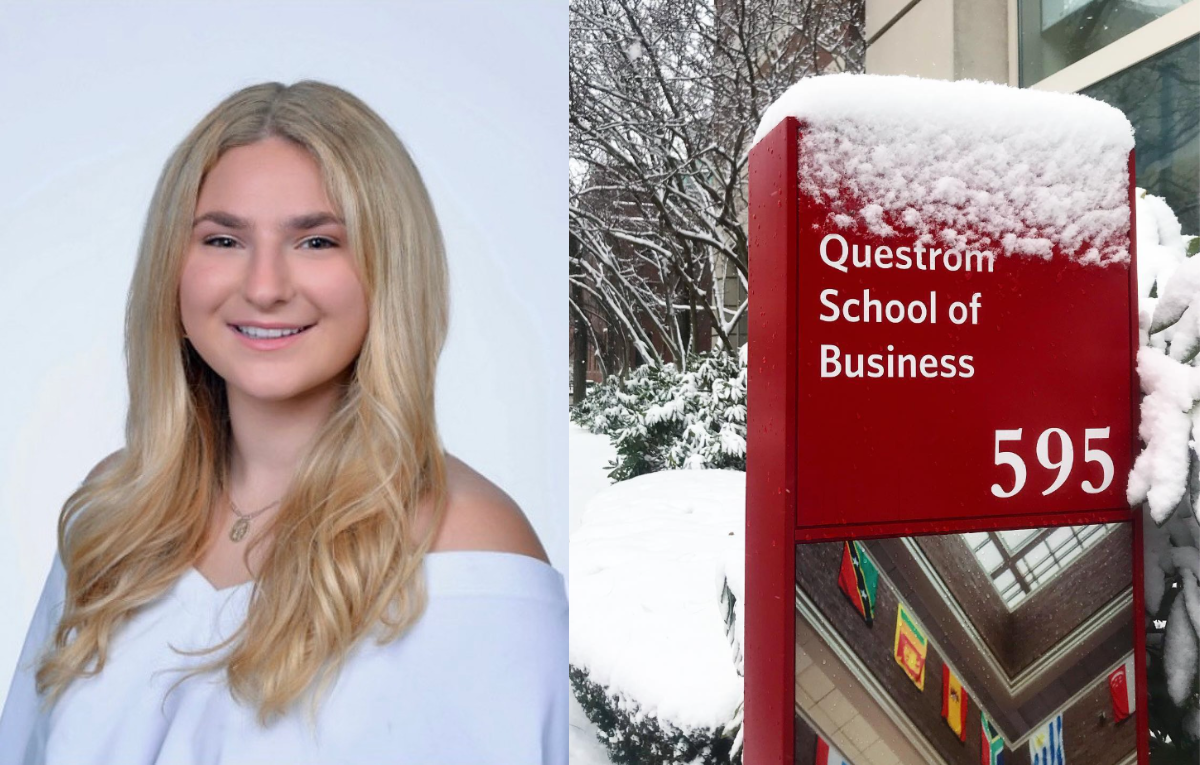
The scent of her late-night cooking creeps under my door as I drift off to sleep. When I leave for class early in the morning, I hear her fervent typing echoing throughout the otherwise quiet house. Her presence lingers in miscellaneous objects left behind like offerings — claw clips on the couch, an empty Owala water bottle on the kitchen counter, well-worn ballet flats by the front door — but she herself never appears.
I’m living with a ghost.
Or maybe I’m just living with Sammy Greenstein.
“I wake up, I do work, I go meet with my team before class, and then I have classes from 2 to 5,” Sammy said. “And then, after class every day, [my group and I] meet usually until 7 or 8. It depends on how much work we have to do. And then after that I go home and do my own work that’s due the next morning at 6 a.m.”
That packed schedule is the reality of Boston University (BU) Questrom School of Business’s cross-functional Core program that Greenstein, a junior studying business administration in the Questrom School of Business, is completing as a degree requirement. The Core program is notoriously difficult. While enrolled in classes in marketing, operations, finance and quantitative methods, students also work on a semester-long business plan project as a group.

Greenstein’s team is developing a prototype for a new skincare product, which has them researching consumer behavior, building financial models, designing operations strategies, and crafting a comprehensive marketing campaign. With the Dec. 2 deadline now just weeks away, she’s completely immersed herself in every stage of the process, gaining a holistic understanding of how a business idea moves from concept to execution.
As Greenstein puts it, it’s “brutal,” but it challenges her to grow as both a student and team member while preparing her for her career.
Tell me about the prototype your team is designing.
The prototype we’re developing is in the personal care industry, specifically under skincare product devices, [and] it’s called the Thermacool Fusion Facial Steamer. It emits both hot steam and cool mist, [and] there’s functions for alternating and doing both in separate intervals.
What differentiates us from the market is that our device has four different drawers that skincare elements and high-viscosity ingredients can go into. These ingredients will be kind of diffused into the steam and be dispensed with the steam for an all-over personalized skincare experience.
What are some of the biggest challenges you’ve faced?
We all have to make sacrifices, but some people are not willing to make as many sacrifices. It’s really hard to meet with everyone. Everyone has different schedules. Everyone has different priorities.
It’s hard to manage a social life and meet up with friends. Throughout the week, I’m burned out. I don’t have a social battery to do anything anymore.
Plus, I have very poor time management, so it’s hard with just the Core stuff. With my other homework, it’s either, ‘Crap, I spent so much time on my homework, I need to grind out on Core this weekend,’ or it’s the other way around, or I haven’t spent enough time doing the internship process.
What have been the highlights of the program so far?
It’s very rewarding getting an understanding of this process. I’m honestly grateful that BU does this program, because I don’t know another time, like later in work, [when] I’d [be able to] understand the process of basically every company in the world. I understand the steps it takes to really make a company work, which I really didn’t have a grasp or understanding of beforehand. I think this project puts me in the shoes of an actual person who’s working [and] making a product from scratch.
With this amount of work, you have to have empathy for what everyone’s situations are, but you also have to understand that at the end of the day, we have to get this done.
Another rewarding part of this process is getting a deliverable done with my team, like turning it in, getting it done, figuring it out, working together. So it helps me be a better teammate, because with this amount of work, you have to have empathy for what everyone’s situations are. But you also have to understand that, at the end of the day, we have to get this done.
How do you think Core will prepare you for future internships, jobs or other classes in Questrom?
One, it will prepare me for interviews. I have something to talk about, a real-life application of work, so companies can hire me and understand that I’ll know how to do things. Two, it will prepare me for teamwork, because while these are my teammates, it’s more like we’re coworkers, because we’re having to work together every day and really figure this out.
I’m just learning a lot of skills that are applicable in real life. I’m not just learning equations and stuff like that — we’re actually putting it to use as an actual company would.
I’ve heard that Core is being discontinued after this year. What do you think of that? How does it make you feel?
I think that’s crazy. Why am I having to do all this work, when the people after me aren’t going to have to do this? I also feel bad that these kids aren’t going to experience [Core] because I honestly think that, while I hate it and it’s low-key crazy, it’ll help me for the rest of my life. Everyone says it’s brutal while they’re doing it, but after, they’re like, ‘Oh my God, I did Core. I talked about that during my interview for a company, and it got me [the job].”
Click here to know more about Boston University’s Questrom School of Business and its programs.


Leave a Reply