

When Professor Monique Kelley first entered Boston University as an undergraduate, she never imagined a future in communications. Pivoting from nutrition to public relations, Kelley is now a multi-hyphenate, successfully juggling multiple lines of work with intention and grace.

Between leading her fractional communications business, teaching full-time at BU, advising the BU chapter of the Public Relations Student Society of America (PRSSA), and recently publishing a book on effective networking, Kelley’s days are packed. On any given week, she is on campus teaching and off-campus consulting for Fortune 50 and global biopharmaceutical companies — all while finding time to write bylined articles and speak about her new publication on TV affiliate and radio stations, podcasts, and with organizations.
While fulfilling her numerous roles, Kelley prioritizes based on this guiding principle: Focus on what matters most. “You’re not going to get everything perfectly,” she said. “You’re never going to have enough time to proof everything. You’re never going to have time to do everything, but do what matters.”
Part of what matters to Kelley is “paying it forward,” something she brings into her teaching at BU.
“The best part of teaching at my alma mater has been not only giving back to a college that was very good to me… but the one-on-one conversations where I’m making an impact for people with mental health challenges or other obstacles,” said Kelley. “We are all human. When a student feels comfortable enough to open up to me, I don’t take that lightly.”
As a BU COM alum, Kelley saw the value of COM courses in teaching “a profession,” rather than “a lot of theory that [she] wouldn’t use.” She aims to carry this forward in her CM 441 (Media Strategies and Management), CM 313 (Corporate Communication), and CO 145 (COM Career Readiness) courses.
Kelley brings in “real-world experiences” for students, setting up mock new-business pitches with leaders from top companies like Microsoft, Spotify, Duolingo, and the franchise owners of Ben & Jerry’s and Chick-fil-A Boston. She also invites global guest lecturers from all paths of communications — even marketing — to offset her own healthcare experience.
Of her courses, CO 145 (COM Career Readiness) is the most recent addition to the COM roster. Created in tandem with Communication Director Dana Janbek and Director of COM Career Services Heather Fink, the eight-week course provides guidance on everything early-career related, like LinkedIn, networking, resume and cover letter writing, and interview preparation with an industry recruiter. Students can register for this class through the MyBUStudent registration portal on their registration start date and time.
As the only professor to teach the course to date, Kelley has seen firsthand the value students gain from CO 145. “Every semester, the students vote to expand the class… They are clearly craving more, and most tell me that this class provides them with information that they haven’t learned before.”
While Kelley works with the college to expand the curriculum, she is still making the most of the second half of the semester. She creates a community within her class and emphasizes that she is still available as a career coach, even after those eight weeks.
“For me,” said Kelley, “it was never a class. I see my role as a professor of the practice really as a career coach and somebody who can help them with the transition between academia and industry. It’s a different mindset and set of rules. What got them into BU won’t necessarily make them impactful in communications — the business I’m still working in.”
I see my role as a professor of the practice really as a career coach.
Beyond BU, Kelley is an entrepreneur and the author of “Redefining Networking: How to Lead with Your Unique Value.” Along with her insights on networking, the book features essays from Kelley’s professional contacts — a feat of networking unto itself.
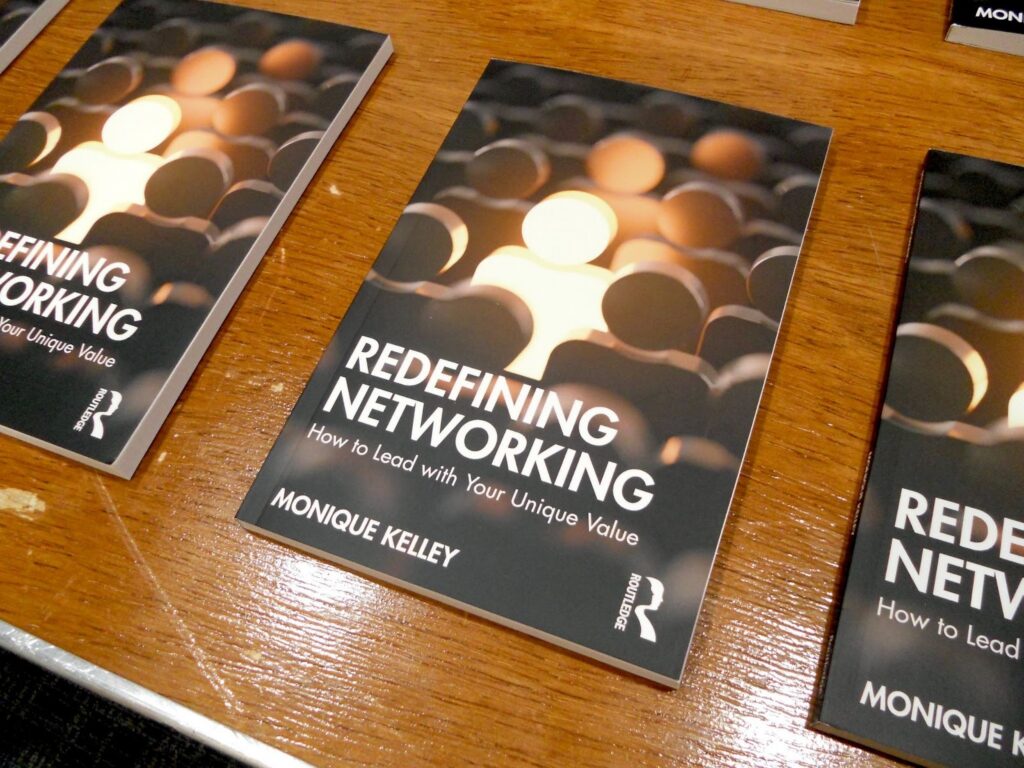
In the book, Kelley discusses the common roadblocks readers may face when thinking about “networking,” but as the title suggests, Kelley breaks down the barriers and redefines it, focusing on intentionality, communicating value, and “paying it forward.” The book can be found on Amazon, Barnes & Noble, and Bookshop.
“Hope is not a strategy,” she said. “Students and professionals alike should stay open to opportunities that come up, but be clear on your purpose, values, and what you want to contribute. None of what I’m doing now was originally planned — it came from contributing to my network and being open to new possibilities I learned about through it.”
For students and young professionals, Kelley suggests “playing connector” — connecting people in your network when opportunities or requests for help arise. According to Kelley, this can be as simple as referring opportunities to your friends or introducing your roommate to a guest speaker with expertise in their field.
“Be open and curious to the other classmates around you and think about how you might be able to help them,” said Kelley. “It’s never too early to play connector and to be thinking about how to give value to others, even when the others are classmates.”
It’s never too early to play connector.
This mindset toward networking is what helped Monique Kelley Consulting LLC take off. Her clients of three and a half years were those who understood her value, who have been with her since the agency launched. They had previously worked with her or were referred by those in her network. Additionally, her network at CHIEF, an organization that advances women leaders, supported her in starting up her consultancy.
As a founding member of CHIEF Boston, Kelley has met at least once a month with other women executives for the past five years, showing up and staying engaged with her network. “It’s great,” she said, “because you can contribute to the group, but also you can learn from the group.”

(Photo/Monique Kelley)
In the face of so many roles that all demand her attention, Kelley emphasizes the need for clear boundary-setting. “Before, I used to be very open — whenever a student or client needed me, I’d jump.”
Nowadays, Kelley encourages students to come to her office hours first, before finding another mutual time to meet. On the other hand, her clients know that she teaches Tuesdays and Thursdays, and she no longer feels the need to check in at every turn on those days.
“Anyone who cares for me doesn’t want to see me burn out, so I keep that in mind,” she said. “I’m at my best when I’m also healthy, when I’m sleeping, when I’m eating well, when I’m working out, when I give myself the time to do nothing. All those things contribute to me showing up the way I want to with students and peers.”
And, as Kelley shares with students, “It’s about being responsive, not reactive.” To her, being responsive comes from a place of strength — of wanting to help and be present — whereas a reactive space and the back-and-forth it spawns can be more nerve-wracking for students. As an educator and career coach, she urges students to be mindful of where they are using their time and energy.
“If we all just took a breath and gave ourselves the grace… I think it’ll have a positive cascade or domino effect of less urgency and more intention.”
Professor Kelley would love for readers to engage with her via LinkedIn.






Leave a Reply