

Technology is evolving — and so is the BU College of Communication. From artificial intelligence-focused advertising and writing classes, to revised policies on digital tools, COM leverages technology to strengthen students’ skills and learning. Some professors, however, still rely on one old-school method for learning:
Note-taking with a notebook and pen — not a computer.
COM students rely heavily on note-taking for success. It would be impossible to retain the information tossed around in COM’s notoriously long classes, meet tight-squeeze deadlines, or remember every film recommendation without notes. Many COM students attempt to transcribe everything discussed in class word-for-word — something we can only achieve by typing. COM professors Michelle Sullivan and Kathryn Burak argue otherwise. Sometimes, less is more.
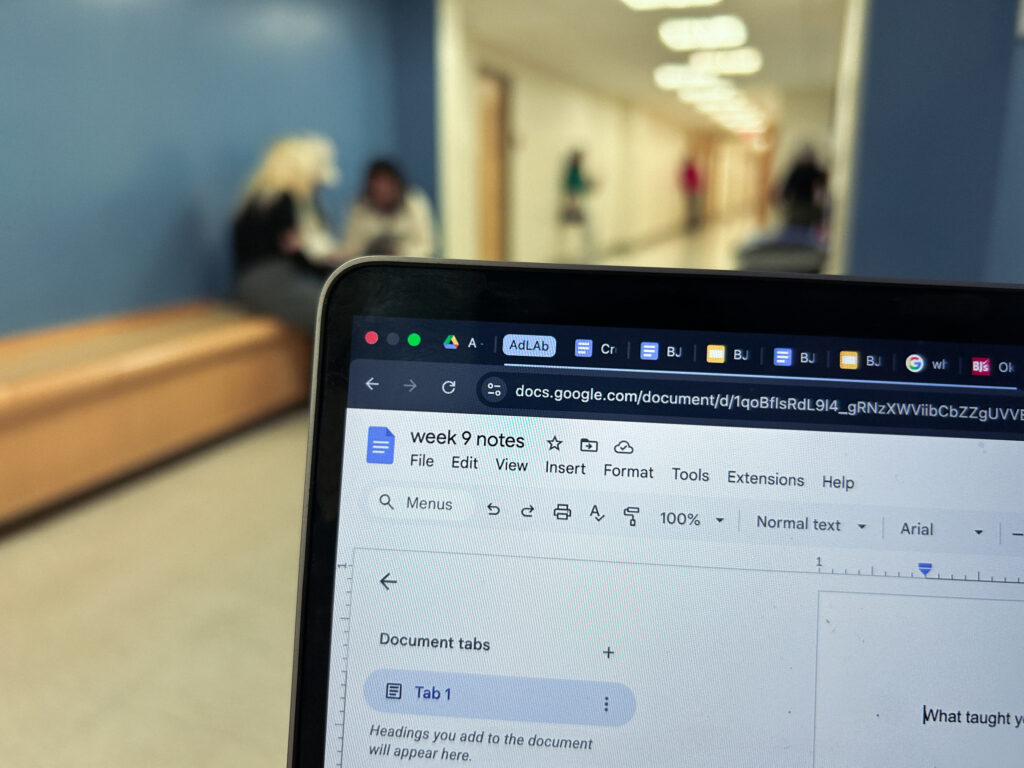
“[Computers are] just like candy, right?” said Sullivan, a professor of the practice who teaches courses in mass communication, brand management, and advertising. “You know, catnip in front of a cat. It’s like, people, all of a sudden, are going off onto their email and instant messenger, and they are checking Basecamp for AdLab, and going down all these rabbit holes. It is actually a distraction.”

The Distraction Problem
“Students feel like [computers are] a tool for them. I don’t believe that. I believe it’s a distraction.”
We are one click away from losing track of class when our computers are on. This is not a mind-blowing advertising insight – just a simple observation that is often overlooked.
“I would be going over a grammar quiz, and I would call on someone. I’d say, ‘Can you do No. 8?’ and [the student] would say ‘Oh, I have a question on No. 6,’” said Burak, master lecturer. “If they have screens up, they’re not listening to my voice. But they always want to take notes.”
“Students feel like [computers are] a tool for them,” Sullivan said. “I don’t believe that. I believe they’re a distraction.” But she believes that even the students who manage to stay on their notes tab learn ineffectively. “There is a lot [of research] that validates how distracting and ineffective computers and electronic devices are in the classroom, and that sort of took me into finding what is really effective, [which is] the handwritten notes.”
The Processing Issue
Sullivan argues that typing notes on computers hinders students’ ability to process and retain information. “When people are typing their notes, they’re not really processing and learning the material. They are actually just transcribing it,” Sullivan said. “You’re literally just making a written record without giving it any thought.
“It’s harder to write the notes [because] the brain has to go through seven different steps to write. So, when you’re writing on paper, you’re not necessarily just regurgitating what I’ve said. You’re writing down what you’ve learned.”
The Multitasking Phenomenon
Both Burak and Sullivan suggest that distraction often disguises itself as productivity. “I would ask my students, and they would say, ‘Oh yeah, I’m really good at multitasking,’” Burak said. “And I thought, yeah, you’re not that good because you’re not really following the directions or asking questions.”
“I’m a crazy multitasker too, but I try to think of the ways that I really can multitask,” Sullivan said. She says multitasking doesn’t belong in a classroom setting.
Professor Burak’s Unique Solution
When it comes to tackling this issue, Professor Burak is taking a rather old-fashioned approach. “I provide my students with notebooks that I bought for them, and they seem to cherish their notebooks,” Burak said. “They’re these spiral-bound, 70-page notebooks, and they come in all different colors. It’s interesting [because] they really take care of their notebooks. It’s just heartwarming to me.” The cheap notebooks she bought from Target act as a learning ritual for her students.
The Agency In Note-Taking
Still, both Sullivan and Burak allow their students to decide for themselves in the classroom. “It doesn’t matter to me,” Sullivan said. “I want the students to make their own decisions.” She emphasized that note-taking habits should align with students’ intentions.
“In one class, you might not need to retain the information as much,” she said. “But, if it’s a really important learning topic for the student, then, maybe, going the handwritten route is better.”
Sullivan also highlighted that some students have legitimate reasons to type their notes. “I know that certain folks need to use the computer for translation reasons or [due to] several learning differences, like dyslexia, and it can be really helpful,” she said.
Burak’s response was similar. “It’s not 100% of the time,” she said, highlighting that some students rely on computers for reasons as simple as bad handwriting.
“I think handwritten notes are a game-changer.”
As COM continues to embrace technology, Sullivan and Burak emphasize that analog persists as a tool to retain information. “I think handwritten notes are a game-changer,” Sullivan said. In an environment where we are surrounded by complex technology, the most effective learning method remains the simplest — a pen, a notebook, and full attention.



Leave a Reply