
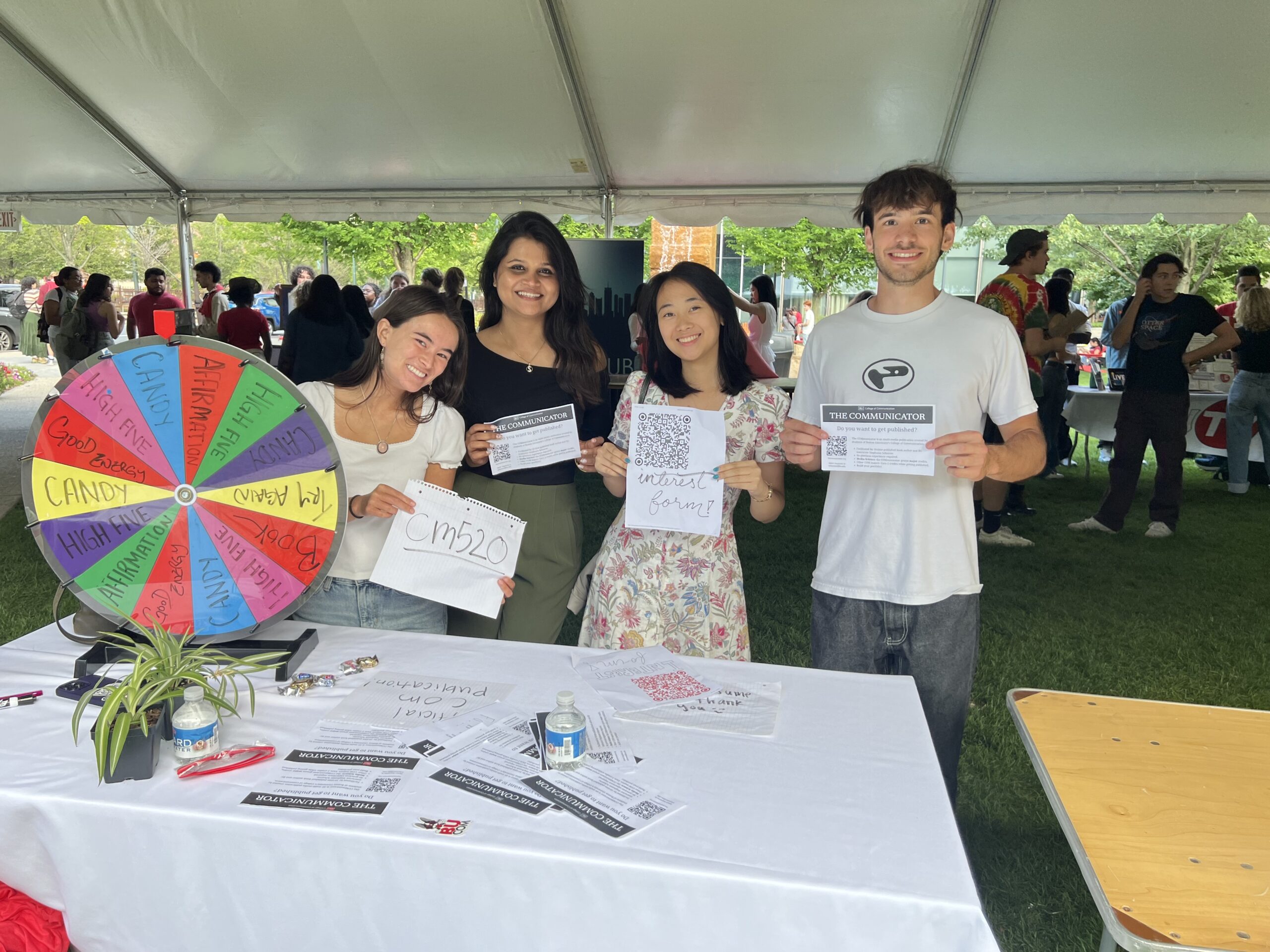
Calling all COM students: Are you a writer? A photographer? Interested in social media or marketing? Do you dream of having free reign to write your own column, design your own editorial or shoot your own video?
The COMmunicator, a student-run multimedia website dedicated to highlighting the College of Communication, is looking for students like you to join our team.
“The Communicator really allows COM students to get involved with their community, the COM community literally, but then also experience working on a publication, building a website, and working with a team if they haven’t had that experience before,” said 2023-2024 Editor-in-Chief Danielle Witter.
“Working for the COMmunicator allows students to develop different skills in writing, in social media, in editing, and in an overall organization,” said faculty advisor Stephanie Schorow, a COM instructor.
The COMmunicator offers a 2-credit course that meets once a week, fulfilling the CO 575 requirement for COM students. Even if students cannot commit to the course, they can still volunteer or contribute to the publication to build their portfolio
Founded in 2009, the COMmunicator’s start was slow prior to this semester, Spring 2023. Managing Editor Brielle Tuvim describes that the contributors consisted of only six people, and “everyone was writing as much as possible to produce as much as we could to try to build a good foundation for the publication before we got a staff.”
“I think that’s really amazing that we’re building it back up to a more known publication again, because I think a lot of people don’t remember it or haven’t heard of it,” said former Senior Editor Chloe Cramutola. “I think the idea of all of us kind of coming together and rebuilding this website and this community is pretty cool for the Communication school, to promote other COM majors and the awesome stuff that the Communication school is doing.”
Witter echoes Cramutola’s appreciation of the publication’s focus on communication, saying, “Other publications are more for bigger events and publicizing/highlighting the event, versus the COMmunicator which is focused on the individual and highlighting what the individual is doing.”
Witter feels that exemplary work by both students and professors and has a place for recognition, thanks to the COMmunicator’s focus.
“A lot of COM professors are professors in practice, and so they’re doing a lot of work outside of BU,” she said. “It’s great to touch on that and have other students know that,” said Witter.
Cramutola and Witter were not only drawn to The COMmunicator’s commitment to COM, but to its distinctive and diverse format.
“I think it’s great to have a more multimedia edge, because while there’s other publications, like magazines, podcasts, and TV, I like the idea that, here, we’re combining a lot of different things.” With a wide selection of extracurriculars for BU students to choose from, The COMmunicator’s multimedia format gives its staff considerable creative freedom to produce news articles, op-eds, videos, podcasts, and original photography.
“One of the reasons I was drawn to it was that it was a web-based publication,” former managing editor Brielle Tuvim added. “I knew that a lot of the other publications are print-based or not completely web-based.”
Not only does the staff have the opportunity to produce a diverse range of content, but students can tailor their involvement to match their interests and professional goals. Students can focus on management, writing, editing or visual media and design.
As Tuvim reflects, the initial week of joining the team sets a fast pace, allowing students to immerse themselves quickly and get started on their respective roles.
“I think during the first week once you meet everyone, you’re really thrown into it pretty quickly and we hit the ground running,” Tuvim said.
Jumping into producing content allows students to build their portfolios in a visceral, robust way. “You’ll have something to show for your work,” Schorow said.
But Tuvim stresses that students prioritize quality over quantity at the COMmunicator. “Branching off and doing something you’re really passionate about is often more important than getting the checkmark for completion just by getting something done for a deadline,” she said.
The COMmunicator will not only benefit from the infusion of fresh and creative writing by new students but also offers them the opportunity to develop leadership skills through collaborative teamwork. For example, Tuvim started as a writer and senior editor before advancing to the role of managing editor.
“It is a great way to get a leadership position and leadership experience. I think it’s an easy way to work your way up because you can start as a writer, and in the next semester, maybe you can work on E-board,” said Witter.
But Witter emphasizes that the staff below her is what makes the driving force of the COMmunicator successful. “With any organization, you have the leadership and then you have everyone else –– the writers, anyone who’s doing social media, photographers. Honestly, everyone else is more important because they’re the ones who are able to put in the work that’s needed for this publication to exist,” Witter said.
While The COMmunicator is listed as a course, it operates more like a professional work environment, offering experiential learning opportunities. Students should be prepared to work independently and take initiative in shaping their assignments and projects.
“This is not a normal class where the professor hands you assignments and you do them. You come up with the assignments. You make sure they’re done. You basically teach yourselves.” Schorow said.
Many COM students may already be familiar with experiential learning via Ad Lab, PR Lab, DFP, or BUTV10, but the COMmunicator is one of the only publications that’s specifically geared toward Media Science majors, according to Tuvim.
“It’s one of the only ones that I feel is actually aligning with some of the things I’ve learned in my Media Science degree and will take on as I go into my career,” she said.
Witter emphasizes that the COMmunicator supplements not only students’ academics, but also their campus life in general.
“It allows COM students to write about their own community and get more involved, and the College of Communication is really big on experience and being hands-on and doing professional work in connection with learning and academics,” Witter said.
The newness of the COMmunicator allows for unusual publicity and branding opportunities. Students can build a new publication’s image and brand identity from the ground up.
“This class gives you a great opportunity to develop the kind of publication you want to read. You determine the content, not the professor. You determine how it looks, not the professor. You will decide how to promote it among your peers,” Schorow said.
The small environment competes with other BU publications with more hierarchy and bureaucracy, whereas here students have the creative freedom to produce their own independent work.
“I know everyone’s name and I have a much better relationship with everybody. I think that people feel that among each other as well because it is so small and you’re able to actually chat with people during meetings,” said Tuvim. “I think that it facilitates friendships, and not just friendships, but also professional relationships, like learning how to work with others.”
The balance of friendships and developing professional relationships is fostered through the staff’s smaller size, which enables creative exploration “because it’s not as large as other publications, so it’s not as rigid and you can get peer help on your work,” explained Witter.
As Chloe Cramutola aptly puts it, “Come in and just have fun.” This fluid and dynamic atmosphere not only encourages creativity but also allows for the promotion and support of fellow COM students’ work, making it a rewarding experience for all involved.
Cramutola loves getting other COM students’ work out there.
“It is a cool thing to support them,” she said.
Supporting each other’s work is not just cool –– it is what makes The COMmunicator a vibrant and rewarding community for COM students.
All interviews have been edited for length and clarity.

Leave a Reply