
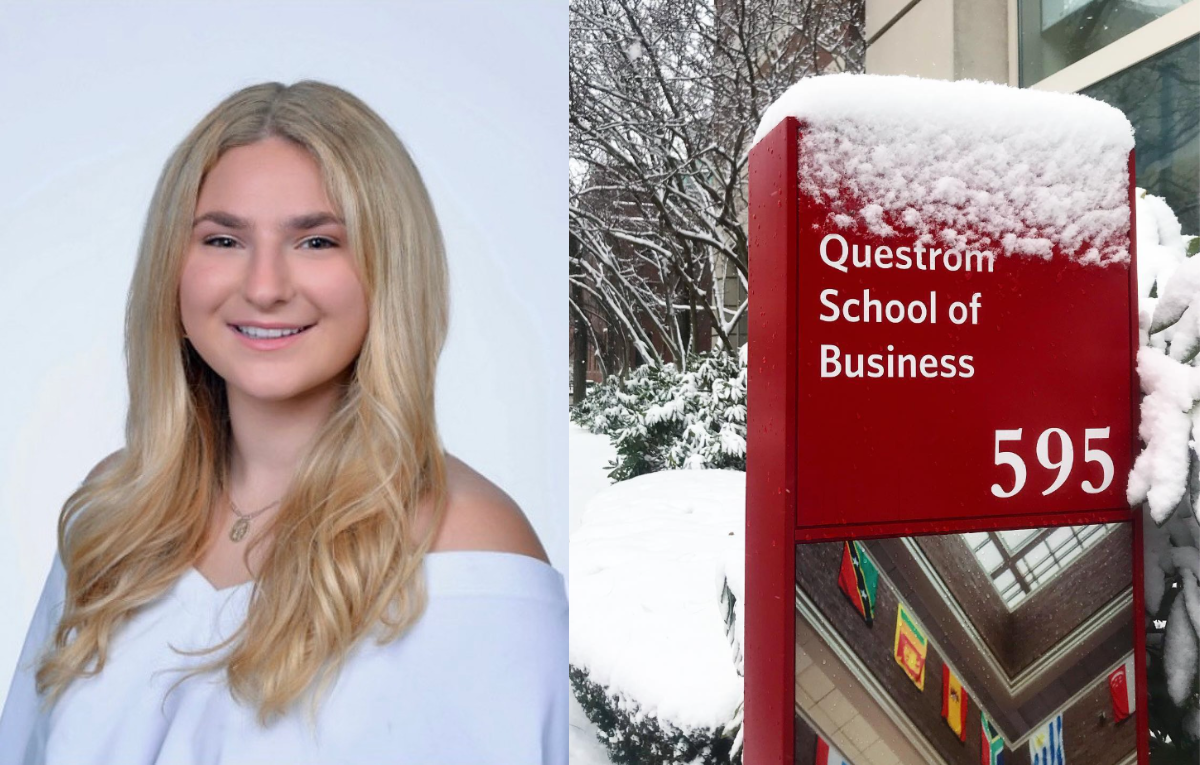
Two years post-graduation, Sara Segal (FTV ‘22) has worked her way up to a Motion Picture Comedy Talent Assistant at Creative Artists Agency (CAA) in Los Angeles. Segal shares invaluable advice for ambitious undergraduates about networking, BU in LA, and launching her career as a recent graduate.
Since graduating from BU, what has your career progression been like so far?
I started at CAA in the mailroom a few months after I graduated. I was in the mailroom for around four months, and then started working for my current boss at the end of December 2022. My boss reps multi-hyphenate comedians. All of her clients are some combination of writers, actors, stand up performers; some do a mix of all three, and some of them are more focused on writing. The clients of the company as a whole are household name comedians, plus a lot of up-and-coming comedians. It’s a very difficult job, but I do really like it. I get to work with a lot of people that I’ve followed for a long time, and have been able to learn a lot.
How did you know you wanted to work in comedy?
I’ve always wanted to work in comedy. That’s something I’ve known ever since I watched SNL for the first time. I was in third grade, and other kids were talking about how their parents let them stay up late to watch the comedy show. I wanted my parents to let me stay up late and watch the show they were all talking about. But of course, which makes this whole thing really ironic, my parents were strict.
My parents would watch SNL, record it on the DVR, and write down the time codes for which sketches they thought were appropriate for a 10 year old. Then, I would watch the sketches with them the next day. The thing is, though, as I watched it, I didn’t understand it! Because I was 10 years old, I didn’t get the jokes, yet I was still fascinated.
In the back of my mind that was always something I really wanted to do. I never thought it was something that was achievable. You know when you’re growing up, and you say you want to be an astronaut, and everyone says, “That’s really cute.” That was kind of the perspective, because I didn’t know anyone who ever actually pursued comedy.
It seemed that this industry was something that was very distant and out of reach. It was something I was steered away from for a long time. But I always found myself having difficulty connecting to what people deemed “safer” or “reasonable” jobs. I continued to gravitate towards comedy. My FYSOP leader freshman year recommended I join Pop Showdown, BUTV’s game show.
My college experience is defined by the people who helped push me to do things. I thought, “Oh, I really can do this thing, and it’s something I can build on in my college career.” I did Pop Showdown from the second I stepped on campus until the second graduated, and I absolutely loved it. Being able to do Pop Showdown for three and a half years, and not getting sick of it, showed me I can do this post-graduation.
Is it intense working at an agency?
Oh yeah. It’s just like everything you hear about agencies. It can be really insane, and can even be scary, to some degree. Sometimes it’s very stereotypical – it is a very high pressure job.
Did the WGA and SAG-AFTRA strikes impact your work at CAA?
Absolutely! I started in January, pre-strike. And then they said, “we’re not only going to have one strike but we’re going to have two.”
Our typical workday is a set pre-overtime 9-6. I usually always work at least one hour of overtime every single day, which is very standard. All of a sudden, it was chaos; what am I supposed to do? Departments like Talent and Scripted cut their work down significantly. No one was getting cast on shows; no one was auditioning. Endorsements, commercials, and stand-up divisions in the company were doing twice the amount of work, while those of us in Scripted and Talent were sitting at our desks twiddling our thumbs.
But, there is always something to do. I think the hours I worked during the strike is similar to what most people work in normal jobs. For example, pre-strike I was getting a call every 10 minutes and would wake up to 50 emails a day. I’d get at least an email every 30 seconds. It’s very fast paced and there is always something coming in. During the strike it was more so an email every minute or two. My desk mates and I would bring books to the office. At some point we had run out of client scripts to read.
You’ve been in LA since you did the BU in LA program your final semester of your senior year. How did this impact the career you have now?
First, I think a lot of people do the BU LA program their senior spring, because that’s the trajectory that they’re suggested to do. In the Film and TV program, a lot of professors say things like, “We can’t teach about these things in Boston. We have to teach about them in LA within the industry.”
People also think they have a higher chance at securing a job if they begin networking a semester early. If you have that mindset, coupled with information from professors and your advisors (who might not have industry experience for many years) it might be a bit misleading. This combination lands a lot of people in LA, to some degree prematurely, without a real understanding of the business, how to get a job, how to properly network, and how to really get your name out.
I did it because I was told this is the right thing to do. You have to move to LA to get a job in this industry. That’s what everyone tells you.
How did doing the LA program translate into starting your career?
My BU upperclassmen friends were how I got my job!
BU LA has a class solely on representation. The entire industry is supported by writers, actors, directors – we know that – but every single one of these people has a team behind them. None of my on-campus courses discussed agents, managers, or publicists, or the people behind all of the faces in the industry.
Representation is a strong force in this industry. In the specific class on representation, you learn about how agencies and management works, and it’s extremely important. A lot of entry-level jobs are assistants to agents and managers. The representation course prepared me for joining an agency team.
What was the best experience doing BU in LA , beyond academics or your career?
The program gets you out there, and that is great.
There were multiple excursions, and you have professors who are working in the industry. You’re exposed to people who are actively in the business, which, compared to the Boston campus, most are not. So, that, at its core, is a really great thing.
What has your experience with networking post-grad been like?
Back on campus, I was very involved with FYSOP, and FY101 – which are very mentorship-heavy activities. I pushed myself intentionally to learn a lot about the resources I had on campus, both for my career and my academic success, but also with helping other students.
I knew that I had many resources in Boston, but, it all comes down to: you don’t know what you don’t know. There is a right and wrong way to network, there’s a right and wrong way to reach out to people on LinkedIn, and there’s a right or wrong way to write a cover letter. These are all things that, in theory, you have access to learn. But, it really comes down to who you work with in career preparation, and lots of trial and error.
My best success has been finding somebody on LinkedIn who not only went to BU, but also did something you did – such as BUTV10 or Freep. I’ve found that, if you reach out to those people, they see the commonalities on your LinkedIn page, and they’re much more likely to answer your requests to chat.
As for my view on networking, I found success in utilizing the upperclassmen that I knew when I was in undergrad who moved to LA before me. Joining BUTV10, joining Pop Showdown when I was a freshman, becoming friends with the juniors and seniors who were on the show, all introduced me to more people. When I came to LA, the most beneficial part, in my view, of the LA experience was not only what I was taught in the classroom. It was reconnecting with the people I lost touch with from COVID, who had graduated during COVID, who now worked full time in the industry and wanted to help me! These people who had full time jobs in the industry, even though I was still in school, wanted to help me and knew I was capable of doing something good.
If I’m thinking about my own network, it’s the people I already knew, and who they introduced me to, that helped me both acclimate when I was in BU LA, but also helped me with writing my resume and practice interviews. That’s really where I relied on my BU network in LA.
These things come with time, but most of your BU network is who you know already, and I don’t think that was really something that was emphasized as much as it could have been while on campus.
When I was on campus, doing FYSOP and FY101, while mentoring a lot of students, I tried my best to instill that in a few people and say: “let me be your resource.”
Do you have any advice for COM students about moving to a big city to pursue a job in a competitive industry?
If you have braved Boston winter you can brave LA summer!
For people in school trying to carve their way into the film and television industry, network in a way that is comfortable.
Do not view your classmates as competition – no matter how hard they try to make you feel that you might be theirs. This is your network and these are your friends. You are all going through it together!
As for moving to LA, it is a very big move, especially if you’re from the East coast. A lot of BU LA people move within a mile from the program residence after graduating. I did the same thing, and I don’t know if I’d do that again. If you’re doing BU in LA, take time to understand the city.
I think overall, any advice I’d give to any student is that a world exists outside of your classroom and it is your responsibility to find it.
This interview has been edited for length and clarity.


Leave a Reply